
Getting Gray County Court Records
Kansas CaseSearch is the first stop for a public Gray County District Court case. It shows the case number, type, parties, judge, dates, and the events index. Finding the file there is easy. Viewing every pleading or order is not guaranteed, though. What appears as an image depends on the court's eCourt and CCMS start date. The filing workflow, the document type, and the public-access rule also matter. The Sixteenth Judicial District joined the statewide rollout track in 2024. That is a transition marker. It is not proof. Not all older paper records are online.
When something is not available remotely, try the courthouse public terminal. You can also call Angela Bowlin, Clerk of the District Court, at 620-855-3812. The courthouse sits at 300 S. Main Street, Cimarron, Kansas 67835. A focused written request works too. The clerk can confirm mailing instructions by phone or accept the official court-record KORA form. Note that the Gray County Clerk, as the county Freedom of Information Officer, handles county-government records. It is not a second custodian for District Court files.
- Find the court, case number, type, and relevant date range.
- Identify the exact event, document, inspection, or copy needed.
- Check CaseSearch, then the courthouse terminal if appropriate.
- Send a focused request to the District Court clerk by the accepted channel.
- State whether the copy should be plain, certified, mailed, emailed, or picked up.
- Ask for a written estimate before approving a large copy job.
Gray County Court Record Layers
Gray County court research runs on three layers. The index layer is case information. Expect a number, type, parties, attorneys, judge, filing date, hearing dates, and status. Then comes the dated activity layer, the register of action or events index. Documents and official copies form the third layer. It holds complaints, petitions, motions, orders, judgments, exhibits, and transcripts.
The online portal handles the first two layers best. A visible event proves an order was entered, yet the text of that order may stay hidden. The courthouse terminal can offer more public material. Certification, though, always requires the custodian. Under Rule 106B, an electronic copy is not the official court record, so never describe a downloaded file as court-authenticated.
Court Record Types
Criminal, civil, domestic-relations, probate, juvenile, traffic, mental-health, and other District Court matters all sit with the District Court clerk. Access limits still apply. Public parts can include registers of action, pleadings, motions, orders, judgments, and docketed hearing information. A municipal clerk keeps city ordinance files. County-government material belongs to the Gray County Clerk. District of Kansas records stay with a federal clerk.
A transcript is not a docket printout. It is a verbatim record, prepared from a reported or recorded proceeding when one exists. Ask whether the hearing was recorded. Ask who the reporter or transcriber is. Ask whether a transcript already exists, and what current rate applies. Exhibits and audio can carry their own retention, privacy, and copying rules. Correct custody is the first test for every request.
Gray County Court Record Form
The official Kansas court-record KORA form, updated in 2026, is built for this. It lets a requester select a county District Court and describe the record. The requester chooses delivery. The form also certifies the information will not be used for a prohibited commercial purpose. The strongest request names Gray County District Court. It gives the case number. It supplies a date range and identifies the exact filing or event. Say whether you want inspection or an ordinary or certified copy.
| Form field | What to provide |
|---|---|
| Court | Gray County District Court |
| Requester details | Name and current contact information |
| Record description | Case number, document, event, and date |
| Delivery | Email, mail, pickup, or fax when accepted |
| Copy type | Inspection, plain copy, or certified copy |
| Certification | Signature, date, and noncommercial-use statement |
K.S.A. 45-220 lets an office adopt its own request procedures. The form helps because it collects the needed facts. It does not follow that a request fails if it skips the exact form. Call the clerk to confirm the current local procedure before sending sensitive material.
Inside a Gray County Court Record
What is inside depends on the case and the document. A register of action gives brief entries. The file itself may hold the underlying papers. So a public portal result is a locator. It is a procedural summary, not the complete litigation record. An image can be missing for several reasons. The cause could be an older filing, technology timing, case sensitivity, sealing, or a specific document restriction.
| Case identifier | Number, type, caption, court, and filing date. |
|---|---|
| Participants | Public party roles, attorneys, and assigned judge. |
| Events index | Dated activity labels and hearing entries. |
| Filed papers | Public complaints, petitions, motions, and responses when accessible. |
| Court action | Orders, judgments, dispositions, and settings. |
| Access status | Public, redacted, sealed, restricted, or unavailable remotely. |
Read the operative document for its actual terms. An event labeled "order" does not reveal the ruling, and "dismissal" does not explain its reason or effect. The Gray County case lookup can locate the case before you write a document request.
Gray County Court Record Inspection
K.S.A. 45-218 sets out the general Kansas Open Records Act framework. It covers inspection during regular office hours. Exceptions apply. The official statute page spells out the provisions that govern Gray County records access.
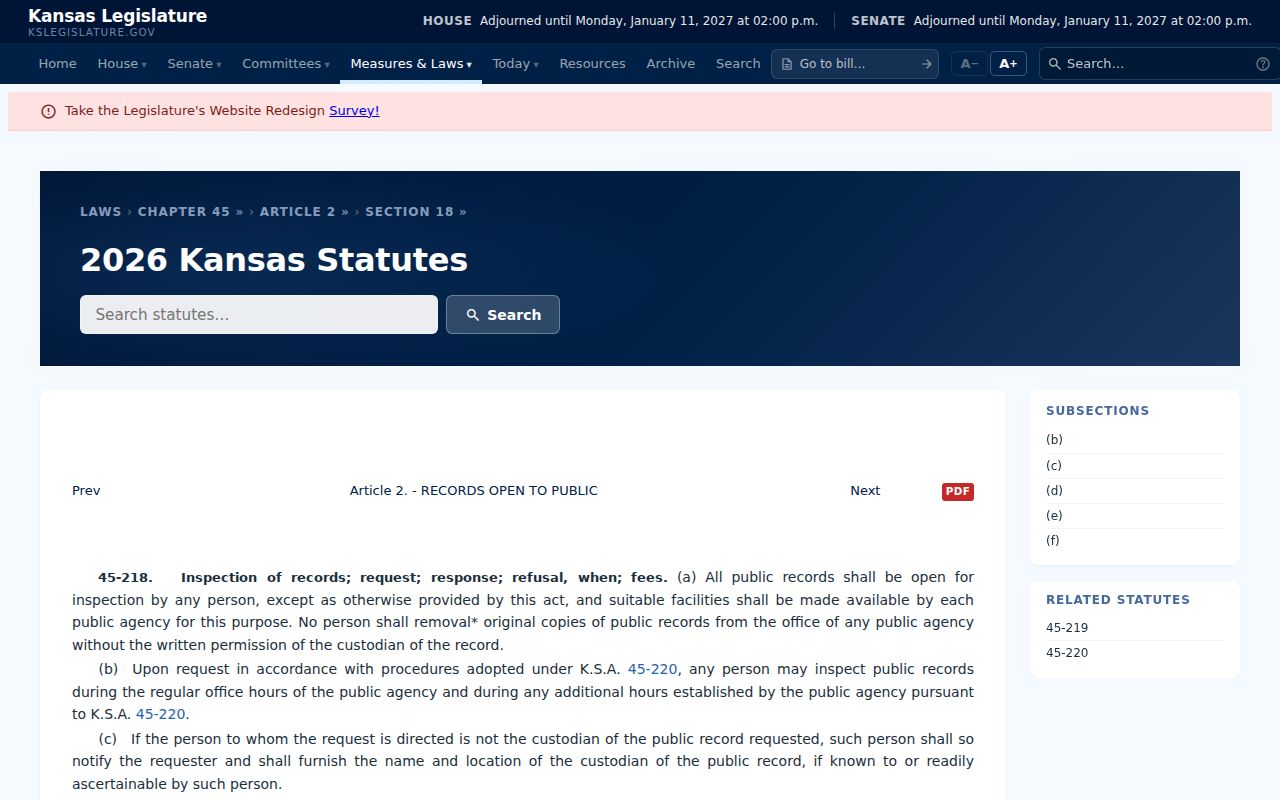
The custodian must act as soon as possible. The outer limit is the end of the third business day. By then the office provides access, explains a delay, or denies access in writing. That is a response deadline only. It is not a promise that a complex file will be copied within three days. Another custodian may hold the material. In that case the request may simply be routed to the right office.
Fees and Certified Copies
Know what you are ordering before you pay. A plain copy is just a reproduction. A certified copy carries the clerk's authentication. A transcript is a product from a separate reporter or transcriber. State filing fees, record-copy charges, certification, postage, media, and payment-vendor convenience charges each carry their own cost. Ask the clerk which charges apply to your exact product.
| Need | Office or source | Published information | Confirm |
|---|---|---|---|
| District Court plain copy | District Court clerk | No current Gray price located | Page, media, postage, deposit |
| Certified copy | District Court clerk | No current Gray price located | Seal and certification charge |
| Transcript | Reporter or transcriber | Older handbook is not a current quote | Rate, format, speed, availability |
| County-government copy | Gray County Clerk | $1 per page on county page | Do not apply it to court copies |
| Filing docket fee | District Court clerk | Dated 2020 district schedule | Current category and surcharge |
The dated Sixteenth District schedule gives filing examples, not a universal copy-price sheet. K.S.A. 45-219 permits copy charges and, in some cases, advance payment. For a large file, request an estimate first. Treat every amount on an old schedule as unverified until the clerk confirms it. Confirm before you rely on any figure.
Gray County Court Record Timing
Under KORA, you should hear back within three business days. The response may grant access. It may deny access in writing, or explain why more time is needed. Production can lag when a request spans many pages. Redaction, older storage, or another custodian can slow it too. Narrow wording cuts delay. Ask for one case, a stated date range, and a named document. Avoid asking for every record tied to a person or every case in Gray County.
Rule 106B limits compiled and bulk court information. The clerk does not have to build a new database or a countywide report from case records. A precise request for an existing public filing stands on different footing. Keep a copy of the request and any cost estimate so the scope stays clear.
Sealed Records and Public Access
Public status and online status are not the same thing. Rule 22 recognizes both the portal and the courthouse terminal. But it keeps sensitive categories and documents off remote access. Material missing online may still be public at the terminal. Sealed, confidential, juvenile, adoption, protection, expunged, and other nonpublic material stays restricted. That holds true no matter the channel.
K.S.A. 60-2617 governs sealing and redaction in covered proceedings. A court applies legal standards; agreement alone is not enough. K.S.A. 45-221 lists KORA exceptions and supports record-by-record analysis. Where practical, nonexempt material can be separated from exempt content. Ask the clerk for the authority behind any denial. Also ask whether a public portion can be released.
Gray County District Court Clerk
Custodian: Angela Bowlin, Clerk of the District Court
Address: 300 S. Main Street, Cimarron, KS 67835; PO Box 487
Phone: 620-855-3812
Role: District Court case records, copies, terminal access, and certification.
Gray County Court Record Procedures
K.S.A. 45-220 sets out the procedures for requesting Kansas public records.
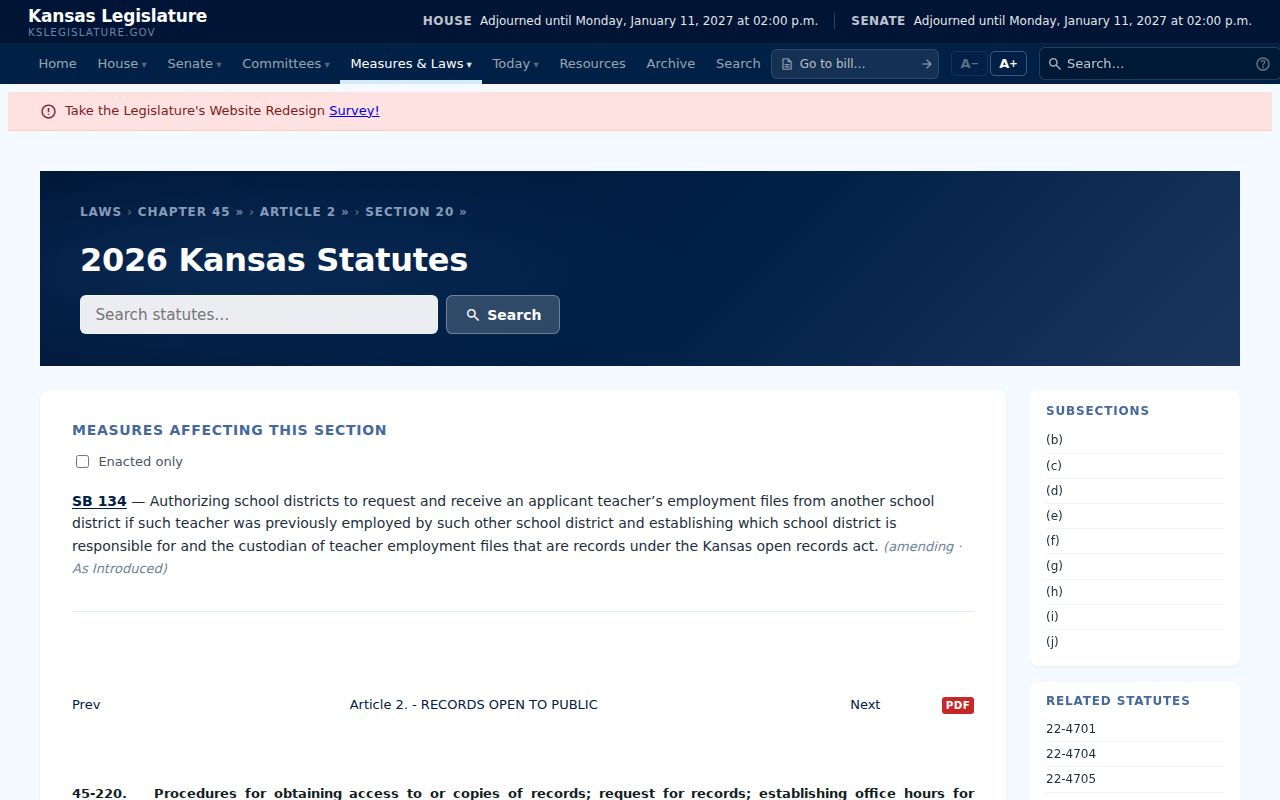
Where does your request actually go? Send District Court records requests straight to the court clerk. Gray County's Freedom of Information Officer is not the automatic destination for court files. Different offices hold different records, so custody comes first. The county clerk handles budget, election, and other county office matters. A municipal clerk, by contrast, is the right contact for city ordinance records. Get the office right up front. That spares you a reply that simply sends your docket request somewhere else.